
1. Introduction
Examination of statutory requirements
Prior to any discussion of this specific project described as the “West Coast Oil Pipeline” As a former practising lawyer and as a Member of Parliament who respects the process of statutory interpretation, I wish to put on record the following.
It is important to note that this is the first use of the Building Canada Act (formerly known as C-5) to be used to designate a project of national interest.
Therefore, it is precedent setting.
The process by which the Privy Council reaches its decision should create a predictable pathway for future projects, and decision makers.
So far, I submit, this government is not off to a good start.
The project description in the notice on the Canada Gazette is factually incorrect. More on that error below.
Ideally, the decision-makers should have clear direction from the law creating the process. Unfortunately, that is difficult as former Bill C-5 only provides the illusion of guidance.
First to the definitions.
The definition of “national interest project” is tautological:
‘national interest project means a project named in Schedule 1.”
The excerpts below make it clear that while the word “criteria” is used, the term is not used in a usual sense to guide a decision. Criteria are provided following the decision. While the word “factors” is used, with the listing of areas of critical public concern, as in the use of the word “criteria,” there are no required elements of a proposal to be satisfied. The “factors” are only suggestions and not requirements. Had they been requirements, the legislation at section 6, would have used the word “shall” and not “may.”
National interest
4.1 (1) The Governor in Council may, by order, for the purposes of section 5, define national interest.
Criteria
(2) In order to promote transparency and predictability, an order made under subsection (1) must set out specific criteria that must be met by the proponent of a project in order for the project to be found to be in the national interest.
Report
(3) If an order is not made within 15 days after the day on which this Act comes into force, the Minister must, within five sitting days of the end of that period, cause to be tabled in each House of Parliament a report that sets out the reasons for the delay and the expected timeline for the making of the order.
Power of Governor in Council
5 (1) If the Governor in Council is of the opinion that a project is in the national interest, the Governor in Council may, on the recommendation of the Minister, by order, amend Schedule 1 to add the name of the project and a detailed description of it, including the location where it is to be carried out.
Factors
(6) In deciding whether to make an order under subsection (1) or (4) in respect of a project, the Governor in Council may consider any factor that the Governor in Council considers relevant, including the extent to which the project can
(a) strengthen Canada’s autonomy, resilience and security;
(b) provide economic or other benefits to Canada;
(c) have a high likelihood of successful execution;
(d) advance the interests of Indigenous peoples; and
(e) contribute to clean growth and to meeting Canada’s objectives with respect to climate change.
These flaws, consisting of a complete lack of guidance to Privy Council, leave the Cabinet with unrestricted political discretion in deciding what is in the “national interest.” The process by which this legislation was rushed through parliament has resulted in a dramatic diminution in the role of Parliament- the Legislative branch of government and a massive increase in the power of the Executive branch – the Prime Minister’s Office and Cabinet. Due to a programming motion brought forward by the governing party and supported by the Official Opposition, Bill C-5 went from Second Reading through committee, clause by clause, Report Stage and Third Reading between Monday June 16, 2025 to Friday June 20, 2025. Senate did as instructed and the bill had Royal Assent without proper study.
This decision will be the first under the Building Canada Act. As such, it would be wise for the Privy Council to establish by precedent what the Cabinet will require of all future projects to be considered in the “national interest.”
The Green Party strongly urges that any project must be supported by an independent assessment of the economic viability of the project. A cost-benefit analysis must be transparent and verified by a third party, such as the Parliamentary Budget Office demonstrating that it is a project that will finish on time and in the black.
Such an analysis is consistent with what we demand of regulations. The Treasury Board’s Policy on Cost-Benefit Analysis, effective September 1, 2018, says:
“Canada’s regulatory policy, set out in the Cabinet Directive on Regulation (the directive), requires departments to analyze the costs and benefits of proposed federal regulations. This Policy on Cost-Benefit Analysis (the policy) outlines mandatory requirements for departments when undertaking such analysis as part of a Regulatory Impact Analysis.
This policy is supported by the Treasury Board of Canada Secretariat’s (TBS’s) Cost-Benefit Analysis Guide, which provides detailed guidance on how to analyze the costs and benefits of proposed regulations.
This sets out a template the Privy Council should adopt as a mandatory pre-condition to any project being listed on Schedule 1 as in the “national interest.”
Especially, as in this case, where public funds are underwriting the project, taxpayers need to know if the project is good value for money. Previous history with political decisions to spend tens of billions on a pipeline without such analysis should serve as a cautionary tale for decision-makers now. The TransMountain pipeline, built by the Crown corporation created for this purpose spend over $34 billion in public funds. While it is reported the TMX “makes money” it has not yet transferred funds to the government sufficient to pay the annual interest costs on the debt on the $34 billion spent in its construction.
Similarly, the public was told the TMX pipeline would diversity our fossil fuel energy exports. However, the Spring Economic Statement in 2026 confirmed that 90% of Canada’s fossil fuel exports still go to the United States. Most of the tankers loaded with diluted bitumen head south to the USA, not East to Asia.
Prior to deciding a second pipeline to British Columbia is in the “national interest” there must be a transparent cost-benefit analysis that examines the market for unprocessed bitumen in other markets.
As Peter Nicholson (a former Deputy Chief of Staff for Policy in the Office of the Prime Minister of Canada and currently serves as Chair of the Board of the Canadian Climate Institute) wrote recently https://sagecanada.substack.com/p/a-pipeline-isnt-a-field-of-dreams “If you build it..” it is not at all clear that there will be sufficient production of bitumen from Alberta to keep the proposed pipeline at 100% capacity.
“The central question is not whether Canada would like another west coast pipeline. It’s whether the oil industry itself sees a commercial opportunity large enough to justify building, and filling, one. A pipeline is not a “Field of Dreams”: it cannot be built simply on the hope that production will eventually materialize. Before committing tens of billions of dollars, investors need confidence that sufficient oil will be available over several decades to generate an adequate return. If there is no convincing answer to that question, the pipeline should not be built.” Peter Nicholson.
Most promotion of the pipeline is predicated on the false claim that Alberta’s production of bitumen has been hampered by federal regulations of various types. This is not the case. In fact, Alberta’s bitumen production is at an all time high.
The volatility of oil prices due to war and other Geo-political stresses must also be assessed. Bitumen is an inherently expensive form of fossil fuel to produce, while also of inherently low value. It remains a solid that must undergo an expensive upgrading process to become synthetic crude. It is only synthetic crude and not bitumen that can be refined. When world oil prices drop below $80/barrel, it is a losing proposition to mine bitumen.
So too should the impact of alternatives for the Canadian economy be assessed. Primary should be consideration of economic impacts for Canada in upgrading and refining raw bitumen in Canada for use in Canada, enhancing self-sufficiency and jobs within Canada. Failure to consider such domestic production alternatives is astonishing given the down-side economic risks, and prior to consideration of other negative impacts.
2. Error in Project Description in Canada Gazette
The failure to accurately describe the project is deeply concerning, with both market, economic and non-economic impacts in any analysis.
The “West Coast Oil Pipeline” was posted in the Canada Gazette. https://gazette.gc.ca/rp-pr/p1/2026/2026-08-01/html/sup1-eng.html
I have bolded the factual error in the Canada Gazette.
The Canada Gazette published a notice on August 1, 2026, to consider listing the West Coast Oil Pipeline Project as a national interest project under the Building Canada Act (details via the Major Projects Office).
Project Overview
• Route: Runs approximately 1,250 km from Bruderheim, Alberta, to a deepwater marine loading facility near Delta, British Columbia.
• Capacity: Transports up to one million barrels of crude oil per day.
• Cost: Estimated between $35.2 billion and $43.7 billion.
• Leadership: Advanced via a partnership involving Trans Mountain Corporation, the Alberta Petroleum Marketing Commission, and Pembina Pipeline
The Project Description from the Government of Alberta makes it clear the product to be shipped is diluted bitumen. The market analysis for the product being shipped is very different for crude oil than for dilbit (diluted bitumen). Crude oil has a much larger range of options to reach refineries that can process crude. Diluted bitumen is far less attractive to industry destinations. Dilbit is essentially a solid at its terminus. The Diluent, used only to allow a solid to be shipped by pipe, is removed after shipment. The solid bitumen must be upgraded to synthetic crude in order to be refined. The Koch brothers in the United States built up refining capacity to handle Venezuelan heavy oil, with processes that also work for oil sands bitumen. Canada used to have 40 refineries. We now have 17. Few of them can upgrade bitumen. So any market review of the viability of the proposed project must consider which refineries are capable of upgrading bitumen. Approximately one third to one half of the bitumen Canada is currently shipping to China is used to pave roads.
In addition to market considerations, shipping dilbit instead of crude oil has significant impacts in the event of a spill. Oil spill response technologies have been designed to manage spills of conventional crude, no technology exists to eliminate the devastating impacts of an oil spill, but conventional crude is more likely to be contained in floating oil booms. Dilbit on the other hand behaves quite differently. The first spill of dilbit that identified this difference was the 2010 freshwater spill in the Kalamazoo River. Enbridge made numerous errors in response to the break in its pipe, all documented by the US National Transportation Safety Board. The dilbit separated. The heavier bitumen sank to the river floor while the “diluent” volatilized into the atmosphere, making people in adjacent neighbourhoods unwell.
https://www.ntsb.gov/investigations/Pages/DCA10MP007.aspx
In 2016 the Royal Society of Canada literature review found that there was insufficient science that dilbit can be cleaned up. DFO studies have found it will separate in a spill in the marine environment, with the bitumen forming oil balls that sink. Natural Resources Canada relied on tests in freshwater vats to which salt was added, the same approach used by Kinder Morgan in its Gainford Alberta “study” that ran for 10 days only. DFO used its real-life facilities in Dartmouth that replicate the ocean environment, using actual sea water. Luck has been with us thus far and no spill of dilbit has occurred on Canada’s coasts. Most experts agree that it is only a matter of time before a dilbit spill occurs. It is not clear that we have adequate technology to deal with such a spill. The likelihood is that the bitumen will sink to the ocean floor while the diluent volatilizes and makes people sick, including increasing their lifetime cancer risk.
3. Impact of the new pipeline routing
The new proposed pipeline route, although advertised as though it “twins” the existing route actually vastly increases the risk to BC wild salmon by running the pipeline along the Fraser River to reach the new (and disastrous) proposed Roberts Bank terminal.
3a: The original Roberts Bank 2 project and threats to Species at Risk
While the promotional materials from the federal government emphasize that there have been many studies on the Roberts Bank expansion, they fail to mention that the studies were for a container port expansion, not for a pipeline terminus and oil tanker port.
Nevertheless, the environmental review of the earlier proposal for the Roberts Bank expansion made it clear it would cause permanent environmental damage threatening numerous species.
In March 2020, the Canadian Impact Assessment Agency concluded that the Terminal 2 expansion project will:
• Cause detrimental impacts on threatened Chinook salmon populations from the Fraser River that feed endangered Southern Resident killer whales.
• Destroy the legally-protected Critical Habitat of Southern Resident killer whales by increasing underwater noise and disturbance, thus reducing the whale’s ability to find and capture their Chinook salmon prey.
The Panel also concluded that these impacts could not be mitigated, offset, or compensated for by the measures proposed by VFPA. Offsetting describes the act of restoring or creating habitat elsewhere to make up for lost habitat as a result of a project.
Of particular concern is the threat to the global population of the Western Sandpiper. The Impact assessment panel acknowledged this threat but lacked sufficient science to make specific findings.
This article in The Narwhal is essential reading for decision-makers prior to fast-tracking a bulldozer over the survival of a species.
“Tiny birds, and their tiny superfood, could decline due to ‘irreversible’ effects of Vancouver port expansion
The Roberts Bank Terminal 2 expansion at Canada’s busiest cargo port could be fast-tracked by the federal government. It’s a major stop for 3.5 million western sandpipers to eat and recharge while travelling the entire Pacific”
By Steph Kwetásel’wet Wood
Photography by Isabelle Groc
Nov. 3, 2025(Updated May 15, 2026
“Microscopic organisms make up the food — called biofilm — which supports the round, fluffy western sandpiper. Biofilm provides the little shorebird fuel as it makes an epic journey between Peru and Alaska. Thousands of western sandpipers fly in artistic murmurations and gently poke their pointy beaks into the mud, scooping up biofilm with hairy tongues. Biofilm is part of the foundation of the food chain that also supports crabs and fish, bears and whales.”…
“Bob Elner, scientist emeritus with Environment and Climate Change Canada and adjunct professor at Simon Fraser University, said evidence suggests this unique richness is due to the spring influx of fresh water from the Fraser River into the salt water, which causes a “shock” in the tiny diatoms, causing them to be highly active and pulse out rich omega-3 fatty acids and other nutrients.
Elner said Roberts Bank “is the largest old unaltered, intertidal estuary” in the province; equivalent banks have been impacted by development. He closely studies western sandpipers, but said they aren’t the only creatures that may decline as a result of changing the biofilm.
“Really, it’s much bigger than that, because those same fatty acids [in the biofilm] are responsible for the eulachan fishery, salmon fisheries and it goes up to orcas and marine mammals. It’s really that transfer of fat — these fatty acids — through the system,” …
“The risk this will occur is very, very high, and the outcome is very predictable — species-wide impact, but also impacts at the fisheries level.”
Shorebirds are one of the “fastest declining groups” of birds in the world, he added. “Much of it, in my professional opinion, is tied to the removal of these sources of active biofilm.”…
“I believe in science,” he added. “The science has been ignored.”
https://thenarwhal.ca/roberts-bank-terminal-western-sandpiper/
Back in April 2023, when the permits were granted. I pointed out that the so-called “binding conditions” would not protect the multiple species at risk.
The excerpt below is from Hansard on June 13, 2023:
“Mr. Speaker, I am rising tonight in Adjournment Proceedings, at a later time than usual, with it being just about one o’clock in the morning, to follow up on a question I asked in question period on April 27. Just before Earth Day, the Government of Canada approved a massive nature-destroying project, a controversial one that has been fought by British Columbians since 2013 when it was first put forward. It is called the Roberts Bank terminal expansion.
I asked the hon. Minister of Transport how it could be justified, with the opposition and the clarity the environmental impact assessment, itself, found, and it is very rare to get such strong language from an environmental assessment review, that there would be significant and irreversible adverse effects that threaten the survival of a number of species. Still, as the Minister of Transport explained, the project was approved because it had 370 binding conditions, and somehow this devastating project was going to be magically purified through those conditions.
I also included in my question my favourite of the conditions, number 14.7.1, which requires that they paint the cranes to be used at this massive port expansion in a colour that is compatible with the surrounding landscapes. The minister responded that there were other conditions as well. I have gone through all those conditions, and there is no doubt that this project threatens the survival of numerous endangered species. The Fraser River estuary is rich in biodiversity, and the environmental assessment points to numerous endangered species with 102 species at risk.
… It is a $3.5-billion project, and it is going to add $3 billion in added GDP, so what are a few species when we really come down to it? This is an absolute violation of everything the government says it stands for.
The Minister of Transport, … said, “the economy and the environment go hand in hand.” No, the economy goes to the bank. The species at risk go to their graves. This will cause species at risk to go extinct.
Besides the very endangered southern resident killer whales, besides the endangered salmon and so many species, I want to mention one in particular because it is so clear that it cannot be moved somewhere else. One of the conditions says that the people are going to find places in mud flats to create more food for this particular species, the western sandpiper. It has a very interesting, almost hairy tongue that manages to get into something called “biofilm” and gets all its nutrients from that. Over 3.5 million western sandpipers, which makes it look like it could not be endangered, but that is the whole global population, stop at some point every single year on Roberts Bank. The biofilm is specific to that area. People cannot move it around. Experts say they cannot move this bird around, so “endangered” mean nothing to the government when its eyes are flashing with dollar signs.” ….
{and this from the former Parliamentary Secretary, Irek Kusmierczyk ‘s response:
“The conditions include protections for marine mammals, including for Southern Resident killer whales. The Vancouver Fraser Port Authority will be required to ensure that the project does not increase underwater vessel noise in the Salish Sea, an important part of minimizing disruptions to the whales…
“These conditions rely on the existing and planned work by the Government of Canada, including all the protection measures in place to reduce the impact of marine traffic on the southern resident killer whales. The announcement in budget 2023 of $152 million to protect endangered whales shows our commitment to doing this important work.
The other conditions imposed on the Vancouver Fraser Port Authority include more than 100 measures to protect the local fauna, as well as develop and implement an adaptive management approach to prevent any adverse impacts on migratory birds. They also set out the requirement to use emissions free handling equipment and to provide enough provisions to the ships when they are docked at the terminal.”
In closing I raised two other points, now forgotten – opposition from the trade unions and the existence of an alternative:
“ The International Longshore and Warehouse Union says that this approval of Roberts Bank threatens jobs because the way the Vancouver Fraser Port Authority wants to operate it is automated. The union thinks it is going to wipe out jobs.
By the way, let us look at the other alternatives. There was another proposal from Global Container Terminals for half as much footprint and less environmental damage. It was not great, but they decided to go with the Roberts Bank, the biggest and most damaging project.” https://www.ourcommons.ca/DocumentViewer/en/44-1/house/sitting-212/hansard
3b: The revamped Roberts Bank 2 project as terminus of new dilbit pipeline
It needs to be asked if the expansion and repurposing of the Roberts Bank expansion, now to include a terminus for a new dilbit pipeline and deep-water port for oil tankers for shipping this hazardous product are bound by the previous conditions. Certainly, the new oil terminus on Roberts Bank will increase shipping and noise and further erode critical habitat for SRKW.
As other briefs have mentioned, notably from the US communities of Washington State on the San Juan islands, this whole area is in a highly active seismic zone. In the case of a large earthquake, this area will experience a rapid disappearance, in a process known as “liquefaction.” The impacts on the adjacent communities and ecosystems are wholly different with the repurposing of a container terminal on Roberts Bank to an oil tanker port and dilbit shipping area.
None of this seems to be considered important, or even moderately interesting, to our new government.
The implicit assumption appears to be that the Roberts Bank project has had sufficient consultation with Indigenous Nations and rights holders and adequate environmental review and study. The ongoing court case from the Lummi Nation of Washington State is being ignored, as is the opposition of Chief Harley Chappell and the Semiahmoo First Nation near Surrey BC.
The reality that this project is substantially different from that first proposed – just as the difference between “crude” and “Dilbit” appear to have escaped the notice of this build fast government. Facts matter. Details matter. Think first, plan well, and then build. This government has ignored facts and science to race to completion for a project without an economic case.
4. Indigenous opposition is strong to dredging Burrard Inlet, to expanding Roberts Bank and to new pipelines
On August 9th, 2026 the Union of BC Indian Chiefs (UNCIC) sent an open letter to the federal and Alberta governments:
Wildfires and Floods are Devastating Communities; Canada and Alberta Must Stop Expanding the Fossil Fuel Industry and Respect First Nations Rights https://www.ubcic.bc.ca/ol_wildfires_floods_idwip2026
On August 13, Athabasca Chipewyan Chief Allan Adam supported the UBCIC: “If the B.C. chiefs say no, I respect what the B.C. chiefs want. ”
5. Climate impacts
If this project is fast-tracked, who can ever believe this prime minister on any issue ever again?
This excerpt is from Hansard, Question Period on October 17. 2025. It was a solemn pledge just hours before the House of Commons voted on the November 4, 2025 federal budget.
Right Hon. Mark Carney (Prime Minister, Lib.):
“I can confirm to this House that we will respect our Paris commitments for climate change, and we are determined to achieve them.
I can confirm with this House that consistent with our Kunming-Montreal commitments, the nature strategy will be released in the coming weeks.”
Since that statement, climate commitments have been broken. Where the budget pledged no Investment Tax credits for enhanced oil recovery, that specific pledge was violated ten days later in the October 27 MOU with Alberta. The government’s climate credentials, never strong, lie in tatters.
The entangled projects of expanding Roberts Bank, dredging Burrard Inlet and building a new pipeline ensure we violate commitments to nature and endangered species as well as to climate.
The government’s own internal process, working with scientists within Environment Canada and Climate Change and academics from across Canada has issued a peer-reviewed, authoritative update. It was released in early September 2026. The review is chilling in confirming the degree to which our economy, communities and ecosystems are at risk. The report makes it clear that dangerous levels of additional warming with attendant negative and dangerous changes for Canadians are now “locked in” by changes to the chemistry of the planetary atmosphere that are irreversible.
These impacts include more extreme drought, flooding, heat domes, wildfires and dangerous weather events of many kinds. The report, unfortunately, could give rise to complacency. If these are “locked in,” why try?
This tendency to complacency is reinforced as analysis after analysis demonstrates Canada is not on track to meet our internationally legally binding commitments under the UNFCCC Paris Agreement.
The most recent assessment from the Canadian Climate Institute finds that we will not hit our 2030 goal, even the initial one tabled with the UNFCCC by the previous administration of former prime minister Stephen Harper in May 2015.
https://climateinstitute.ca/news/canada-more-than-20-years-behind-2030-emissions-target/
According to the Canadian Press article (link below). The office of Environment Minister Julie Dabrusin said Ottawa is still committed to reaching net-zero by 2050 through “a pragmatic and durable approach.”
This statement is typical in attempting to confuse the public with a bait and switch approach to our Paris target.
Our legally binding commitments are those tabled with the Secretariat of the U.N. Framework Convention on Climate Change. Under the terms of the Paris Agreement, these targets, known as Nationally Determined Contributions (NDCs) can be changed at any time, but only to be “ratcheted up,” only to be increasingly ambitious in reducing emissions.
Our initial NDC, from May 2015 was an INDC, pre-Paris and stated as an “Intended NDC”. The Harper target was 30% below 2005 levels by 2030.
In April 2021 the former administration of Justin Trudeau increased our target to 40-45% below 2005 levels.
That remains Canada’s legally binding commitment.
Public and media confusion was created (and I believe deliberately) when the previous government introduced the Climate Accountability Act, C-12, which I opposed for this reason. It ignored our Paris target. It rejected any mention of the core Paris global goal to hold global average temperatures as far below 2 degrees C as possible and to strive to hold global average temperature increase to no more than 1.5 degrees C of warming, as compared to global average temperatures before the Industrial Revolution. Instead, C-12 introduced the target of “net zero by 2050.” This target CANNOT replace the Harper 2030 target nor the Trudeau target for 2030. It amounts to a massive retreat. It creates the false notion that getting to some far distant destination -2050 – is possible and avoids 2 degrees C of global average temperature increase, It cannot. The use of Net Zero by 2050 in the Climate Accountability Act was an act of duplicity by ECCC having confirmed in advance with the Canadian Association of Petroleum Producers that they would go along with the NZ by 2050 goal. Of course they did. It allows growth in emissions for decades with some fanciful notion of rapid cuts at the last minute. As was made very clear by the IPCC Sixth Assessment Report, April 4, 2022, the only way to avoid exceeding 2 degrees C is for rapid cuts in global emissions, at the latest before 2025.”
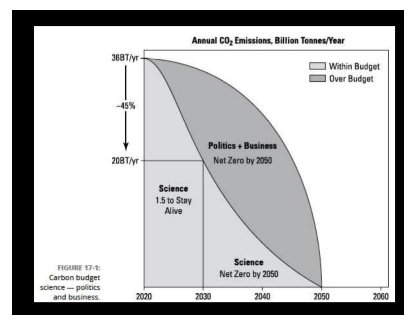
Canada must do far more than is currently anticipated, starting with rejecting any new fossil fuel infrastructure- whether for fracked gas or mining bitumen.
The only fossil fuel infrastructure consistent with reaching Paris targets and building Canada’s economic sovereignty would be expanding Canada’s domestic refinery capacity, particularly to upgrade bitumen to synthetic crude for domestic refining for domestic markets.
The Green Party has advocated ceasing importing any foreign petroleum products and using only Canadian oil until our reliance on fossil fuels is completely phased out. This strategy, “Mission Possible,” was released in 2019. The current proposal is to ship out unprocessed solid bitumen to foreign, primarily US, refineries, exporting domestic jobs with the raw bitumen.
What we learn from the recent Environment Canada report is critical.
The report makes it clear that impacts on Canadian communities, nature and our economy could get very much worse based on global average temperature increase and the extent to which all nations, but particularly the big polluters, like Canada, reduce emissions and how quickly we, collectively do so. That message needs to be incorporated into this government’s thinking- and quickly.
To say the issue requires collective global effort does not absolve our leadership of the requirement to save Canadian lives and communities and other species. Canada has always “punched above our weight” to use Lloyd Axworthy’s phrase.
We are the worst performer in the G-7 on climate.
If even at this late date, we changed course- and committed to the world that we were going to cease reliance on fossil fuels, claim an Energy super-power status as a “Renewable Energy Super Power” and commit to meeting our targets, reject any new fossil fuel infrastructure and use regulations (CEPA part 4) to require facilities to slash their emissions, we could be a leader, encouraging other nations to do the same. The going off oil projects has positive implications for our foreign policy. Shut down all Russian oil. End the dependency on fossil fuels globally that drives war and geopolitical uncertainty. IT aids our efforts to modernize our economy through an east- west north-south electricity gird of 100% renewable energy. This will require a restructuring of our current electricity generating and distributing system. This is the ultimate challenge in reducing interprovincial trade barriers. Only through a tough and frank conversation, transparent so all Canadians can identify the challenges in moving to much cheaper electricity – everywhere can we make it to anything close to our Paris goals.
Our children’s lives and our grandchildren’s future security depend on our actions in the next few years. So, it must be worth it to take the challenge seriously.
On June 17, 2019, the House of Commons voted that we are in a climate emergency.
Building a new pipeline will only confirm that we are a Parliament of liars.